
Peace Economy
“We must see now that the evils of racism, economic exploitation and militarism are all tied together…you can't really get rid of one without getting rid of the other.” -Rev. Dr. King, 1967
"Every gun that is made, every warship launched, every rocket fired signifies, in the final sense, a theft from those who hunger and are not fed, those who are cold and are not clothed." -Dwight D. Eisenhower, 1953
Opinion: To Prevent More Endless Wars, Demilitarize US Foreign Policy and the Federal Budget!
As the longest war in US history, in Afghanistan, recently came to a messy, painful close, it is time to challenge the US policy since the end of World War II of maintaining a large, expensive military during peacetime instead of returning to a much smaller, defense-only military.
As I reflect on the numerous debacles of US military and CIA interventions abroad since 1945, from Korea to Cuba to Vietnam; to Iran, Chile, and Libya; to Lebanon, Afghanistan, and Iraq, I am struck by how wrong-headed and counter-productive they have been. In every case, despite a heavy price in terms of blood and money, they have led to outcomes that were as bad and often worse than before our interventions.
I am reminded of the old adage, “If your only tool is a hammer, then every problem is going to look like a nail.” By relying primarily on the “hammer” of military intervention to address these problems, we have earned a reputation of being a nation that tries to determine the outcomes of problems around the world by engaging in endless wars that seek to violently control what happens in other nations.
Certainly after 9-11, there needed to be a strong response that would prevent further terrorist attacks. But at the time, the global community was united in its determination to work with the US to take such effective action. A much better approach would have been to take full advantage of that solidarity to take a policing/international law approach that would have sought to locate and capture the attackers, bring them to trial, and punish them accordingly. This would have potentially resulted in far less violence and prevented a 20 year “forever” war.
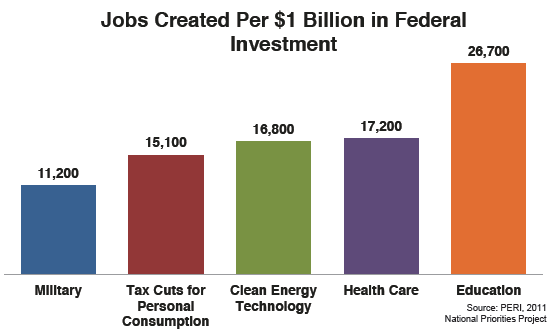
Such “forever” wars are also extremely expensive. But war or no war, the US military budget has remained at 50-60% of the discretionary federal budget, i.e., excluding trust funds like Social Security and Medicare. For 2020, military spending was about $750 billion. Maintaining such an enormously expensive military results in underinvestment in urgent domestic needs like job creation, universal pre-K and free community college, and mitigating the climate catastrophe.
We should move toward a Peace Economy in which we substantially reduce military spending so that it is robustly adequate for defense of the US, but no longer budgets for the US to be constantly ready to intervene militarily in trouble spots around the world.
An additional very large area of savings is the hugely expensive US nuclear modernization program, projected to cost $2 trillion over the next 30 years. We should instead negotiate verifiable nuclear reduction treaties, including eliminating land based nuclear weapons—which are alarmingly prone to being launched accidentally during a crisis.
If we re-allocate a substantial portion of the savings from reducing US military spending toward strengthening diplomacy, and public health, humanitarian, and development assistance to global trouble spots, we would increase security and well-being for ourselves and others. That would bring us much closer to the age-old vision of Peace on Earth.
Readers wanting to learn more or to get involved in advocating policies like the above are encouraged to visit peacecoalition.org.
Sincerely,
The Rev. Robert Moore
The writer has served as Executive Director of the Princeton-based Coalition for Peace Action since 1981.
Opinion: "History Is Clear. America’s Military Is Way Too Big," by Jeremi Suri, the New York Times, Aug. 30, 2021
For much of its history, the United States was a big country with a small peacetime military. World War II changed that permanently: American leaders decided that a country with new global obligations needed a very large peacetime military, including a nuclear arsenal and a worldwide network of bases. They hoped overwhelming military capacity would avert another world war, deter adversaries and encourage foreign countries to follow our wishes.
Yet this military dominance has hardly yielded the promised benefits. The collapse of the American-supported government in Afghanistan, after 20 years of effort and billions of dollars, is just the latest setback in a long narrative of failure.
The war in Afghanistan is much more than a failed intervention. It is stark evidence of how counterproductive global military dominance is to American interests. This military hegemony has brought more defeats than victories and undermined democratic values at home and abroad.
History is clear: We would be better off with more modest, restrained military and strategic goals. U.S. public opinion seems to have moved in this direction, too. Our country needs to re-examine the value of military dominance.
The reliance on military force has repeatedly entangled the United States in distant, costly, long conflicts with self-defeating consequences — in Vietnam, Lebanon, Iraq, Afghanistan and other places. American leaders have consistently assumed that military superiority will compensate for diplomatic and political limitations. Time and again, despite battlefield successes, our military has come up short in achieving stated goals.
In the Korean War, the overestimation of American military power convinced President Harry Truman to authorize the Army to cross into North Korea and approach the border of China. He hoped American soldiers could reunite the divided Korean Peninsula, but instead the incursion set off a wider war with China and a stalemated conflict. Now, after seven decades of American military deployments on the peninsula, the Communist regime in North Korea is as strong as ever, with a growing nuclear arsenal.
In Vietnam, the “best and brightest” experts around President Lyndon Johnson advised him that America’s overwhelming power would crush the insurgency and bolster anti-Communist defenses. The opposite was true. American military escalation increased the popularity of the insurgency while also creating greater South Vietnamese dependence on the United States. Following an offensive by North Vietnam in 1975, American-trained allies collapsed, much as they did in Afghanistan this summer.
The fault lies not with the soldiers, but with the mission. Military forces are not a substitute for the hard work of building representative and effective institutions of governance. Stable societies need to have a foundation of peaceful forms of trade, education and citizen participation.
If anything, the record shows that a large military presence distorts political development, directing it toward combat and policing, not social development. American military occupations have worked best where the governing institutions preceded the arrival of foreign soldiers, as in Germany and Japan after World War II.
American leaders have depended on our armed forces so much because they are so vast and easy to deploy. This is the peril of creating such a large force: The annual budget for the U.S. military has grown to more than a gargantuan $700 billion, and we are more likely to use it, and less likely to build better substitutes.
This means that when nonmilitary overseas jobs like training local government administrators are required, the U.S. military steps in. Other agencies do not have the same capacity. We send soldiers where we need civilians because the soldiers get the resources. And that problem grows worse as the military uses its heft to lobby for yet more money from Congress.
At home, the growth of the armed forces means that American society has become more militarized. Police departments are now equipped with battlefield gear and military equipment, some of it surplus from the Army. Former soldiers have joined the violent extremist groups that have multiplied over the last decade. Less than 10 percent of Americans have served in the military, but 12 percent of those charged in the assault on the Capitol on Jan. 6 had military experience.
Of course, the U.S. military is one of the most professional and patriotic parts of our society. Our uniformed leaders have consistently defended the rule of law, including against a president trying to undermine an election. The trouble stems from how bloated their organizations have become, and how often they are misused.
We must be honest about what the military cannot do. We should allocate our resources to other organizations and agencies that will actually make our country more resilient, prosperous and secure. We will benefit by returning to our history as a big country with a small peacetime military.
"Spend less on weapons, more on programs of social uplift," co-authored by the Rev. Robert Moore & William Hartung, August 13, 2020, Star Ledger
As the House and Senate consider the Pentagon budget this year and in the years to come, they should act to reduce the department’s bloated budget and shift funding to what Rev. Martin Luther King, Jr. described as “programs of social uplift.” New Jersey’s congressional delegation will have an important say in this ongoing debate.
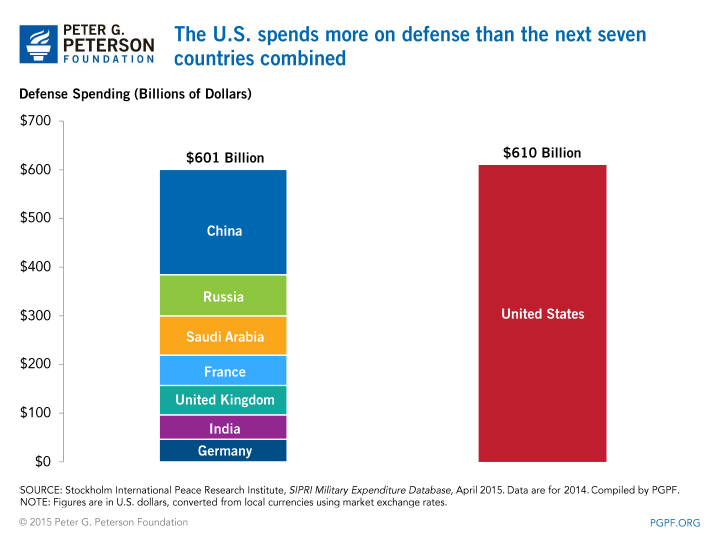
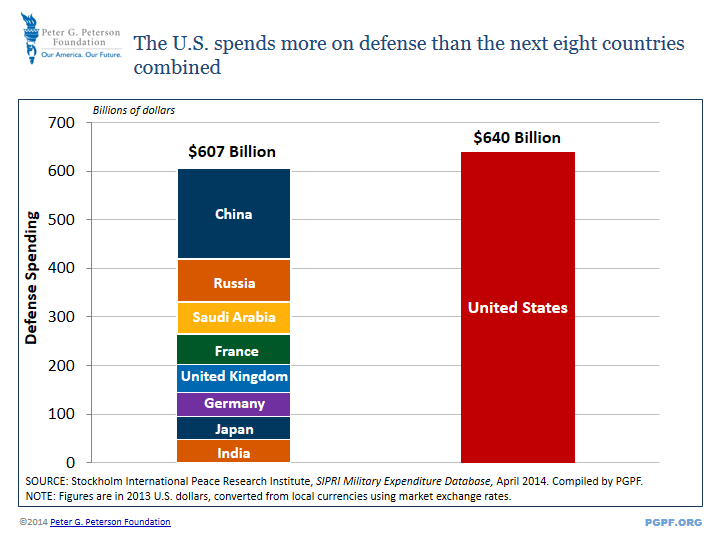
Proposed spending on the Department of Defense comes in at the massive sum of $740 billion this year. That’s more than the levels spent by the next 10 nations in the world combined and higher than expenditures at the peak of the Korean and Vietnam wars. These huge expenditures represent more than half of the federal government’s discretionary budget, squeezing out federal spending on virtually everything it does other than funding for Social Security, Medicare and Medicaid. Discretionary outlays cover investments in housing, education, transportation, job training, the environment, energy development, scientific research, and more.
The COVID-19 pandemic and longstanding demands to address racial and economic inequality cry out for a new approach to protecting Americans who rely less on guns, bombs and aircraft carriers and more on public health and community development initiatives.
Late last month, as a result of initiatives spearheaded by Sen. Bernie Sanders (I-VT) and Representatives Barbara Lee (D-CA) and Mark Pocan (D-WI), Congress had a chance to weigh in on the question of whether to shift funds from the Pentagon to meet other urgent needs. They promoted measures in both houses of Congress to reduce the Pentagon’s top line by 10%, without reducing funding for military personnel or defense health programs.
Adopting this approach would have provided a good down payment on the new approach to security that is sorely needed in this new era, while freeing up urgently needed funds for public health, jobs, education and other essential services in the communities that need them most. Unfortunately, both amendments were defeated, but they received unprecedented support that will set the stage for similar measures next year. Within the New Jersey delegation, Sen. Cory Booker and Representatives Frank Pallone, Donald Payne and Bonnie Watson Coleman voted in favor of the 10% cut.
There is no lack of programs to cut to reach the goal of a 10% reduction in the Pentagon budget. First and foremost, Congress should roll back the Pentagon’s plans to build a new generation of nuclear-armed bombers, missiles, submarines, and warheads at a potential cost of over $2 trillion over the next three decades. Current costs for the nuclear enterprise are running at almost $50 billion per year. These expenditures are both dangerous and unnecessary. The United States possesses thousands of nuclear weapons when experts have suggested that a few hundred would be more than enough to dissuade any nation from attacking the United States. The ultimate goal should be to eliminate these world-threatening weapons altogether.
Of particular concern are land-based, Intercontinental Ballistic Missiles (ICBMs), which former Secretary of Defense William Perry has described as some of the most dangerous weapons in the world because the president would only have a matter of minutes to decide whether to launch them in a crisis, greatly increasing the chance of an accidental nuclear war. The Pentagon wants to triple spending on these risky systems in this year’s proposed budget.
The F-35 combat aircraft is another system ripe for reductions. Analyses by the nonpartisan Project on Government Oversight have shown that the F-35 may never be fully ready for combat, due to a raft of performance and cost issues.
Last but not least is the Pentagon’s massive bureaucracy. A study by the Defense Business Board has indicated that the department could save $25 billion per year just by eliminating excess bureaucracy. The Department of Defense employs over 600,000 private contractors, many of whom do jobs that are redundant, and can be done by government employees for less money.
The debates of this year and next could be critical turning points in how we conceive of our priorities and how we define safety and security. The New Jersey delegation has a critical role to play in these discussions. It’s time to redefine security and focus on the real threats to our lives and livelihoods.
Rev. Robert Moore is the Executive Director of the New Jersey-based Coalition for Peace Action.
William D. Hartung is the Director of the Arms and Security Program at the Center for International Policy.
2020 Updated Pentagon Spending Fact Sheet
"The U.S. is Spending $1.25 Trillion Annually on War," by William T. Hartner and Mandy Smithburger, Truthout, May 7, 2019
"In its latest budget request, the Trump administration is asking for a near-record $750 billion for the Pentagon and related defense activities, an astonishing figure by any measure. If passed by Congress, it will, in fact, be one of the largest military budgets in American history, topping peak levels reached during the Korean and Vietnam Wars. And keep one thing in mind: that $750 billion represents only part of the actual annual cost of our national security state.
There are at least 10 separate pots of money dedicated to fighting wars, preparing for yet more wars, and dealing with the consequences of wars already fought. So the next time a president, a general, a secretary of defense, or a hawkish member of Congress insists that the U.S. military is woefully underfunded, think twice. A careful look at U.S. defense expenditures offers a healthy corrective to such wildly inaccurate claims.
Now, let’s take a brief dollar-by-dollar tour of the U.S. national security state of 2019, tallying the sums up as we go, and see just where we finally land (or perhaps the word should be “soar”), financially speaking. (Read the rest of the article here.)
Poor People's Campaign: The War Economy & Proliferation of Gun Violence
On Tuesday, May 29th, CFPA co-sponsored and participated in a rally by the NJ Poor People's Campaign.
For 40 days, the Poor People's Campaign is holding weekly rallies and direct actions. This week's theme was the war economy and the proliferation of gun violence. CFPA's Executive Director, the Rev. Robert Moore, gave an introductory speech for the rally.
Click here to view Rev. Moore's speech
"Pentagon's new problem after years of crying poverty: Spending all the cash," by David S. Cloud in the Los Angeles Times, March 1, 2018
"After complaining for years that it was starved for cash, the Pentagon now says it may have more money than it can possibly spend.
The windfall is due to a budget deal between Congress and the White House last month that promises an added $80 billion for defense this fiscal year, including a requested $19.6-billion hike for "operations and maintenance" — an all-purpose Pentagon account used to fund troop training, ammunition, maintenance of tanks, warplanes and ships, and other daily needs.
Defense Secretary James N. Mattis pushed for a sharp increase in the account this year, arguing that years of budget wrangling had degraded the military's readiness to wage war.
Congress is still finalizing 2018 appropriations levels for the Pentagon, a delay that has generals and admirals worried about spending all the promised cash in the five months remaining before the end of the fiscal year.
"We have a year's worth of money … and five months to spend it," Gen. Glenn Walters, assistant commandant of the Marine Corps, said at a Senate Armed Services Committee budget hearing.
Critics say that giving the military more money than it can absorb invites waste and abuse, noting that the Pentagon has a long history of overpayments, cost overruns and fiscal shenanigans.
"They cried wolf and now they have more than they can possibly put to use," said Mandy Smithberger, director of the Center for Defense Information, a policy organization critical of Pentagon budget practices. "I think it's dangerous because you are going to see a use-it-or-lose-it kind of spending."" (Read full article here).
The Hidden Costs of “National Security”
Ten Ways Your Tax Dollars Pay for War -- Past, Present, and Future
By William D. Hartung, July 25, 2017, Tom Dispatch
You wouldn’t know it, based on the endless cries for more money coming from the military, politicians, and the president, but these are the best of times for the Pentagon. Spending on the Department of Defense alone is already well in excess of half a trillion dollars a year and counting. Adjusted for inflation, that means it’s higher than at the height of President Ronald Reagan’s massive buildup of the 1980s and is now nearing the post-World War II funding peak. And yet that’s barely half the story. There are hundreds of billions of dollars in “defense” spending that aren’t even counted in the Pentagon budget.
Under the circumstances, laying all this out in grisly detail -- and believe me, when you dive into the figures, they couldn’t be grislier -- is the only way to offer a better sense of the true costs of our wars past, present, and future, and of the funding that is the lifeblood of the national security state. When you do that, you end up with no less than 10 categories of national security spending (only one of which is the Pentagon budget). So steel yourself for a tour of our nation’s trillion-dollar-plus “national security” budget. Given the Pentagon’s penchant for wasting money and our government’s record of engaging in dangerously misguided wars without end, it’s clear that a large portion of this massive investment of taxpayer dollars isn’t making anyone any safer. (Read Complete Article).
President Trump's Budget Proposal
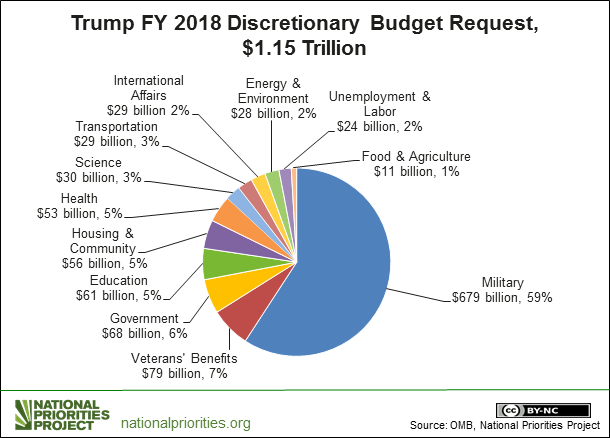
The American Way of War Is a Budget-Breaker
By William D. Hartung, May 10, 2017 Foreign Policy In Focus

The wars America is already fighting are going to cost trillions. The cost of the ones to come is almost incomprehensible.
When Donald Trump wanted to “do something” about the use of chemical weapons on civilians in Syria, he had the U.S. Navy lob 59 cruise missiles at a Syrian airfield (cost: $89 million). The strike was symbolic at best, as the Assad regime ran bombing missions from the same airfield the very next day, but it did underscore one thing: the immense costs of military action of just about any sort in our era. (Read Complete Article).
Results from our 2017 Virtual Penny Poll:

See the results of CFPA's 2017 Online Virtual Penny Poll on federal budget priorities below:
Categories voted Highest Priority
Environment (32%)
Education (30%)
Health Care (27%)
Housing (9%)
Military (2%)
Click here for a fact sheet on U.S. Military Spending (2016)
Source
Will reducing military spending leave America vulnerable to attack?
The defense budget can and should be reduced without presenting any risk to our country.
America’s staggering defense budget, in charts
On Monday afternoon, President Obama will nominate former Nebraska senator Chuck Hagel (R) as secretary of defense. The confirmation hearings are likely to focus on Hagel's views on Israel and Iran. Yet the biggest headache likely to face the next defense secretary will almost certainly be the U.S. military budget.  The United States spends far more than any other country on defense and security. Since 2001, the base defense budget has soared from $287 billion to $530 billion — and that's before accounting for the primary costs of the Iraq and Afghanistan wars. But now that those wars are ending and austerity is back in vogue, the Pentagon will have to start tightening its belt in 2013 and beyond. If Hagel gets confirmed as secretary of defense, he'll have to figure out how best to do that. (Read Complete Article)
The United States is Number 1-But in What?
By Lawrence Wittner October 12 History News Network
American politicians are fond of telling their audiences that the United States is the greatest country in the world. Is there any evidence for this claim? Click here to read complete article.
American politicians are fond of telling their audiences that the United States is the greatest country in the world. Is there any evidence for this claim?
Well, yes. When it comes to violence and preparations for violence, the United States is, indeed, No. 1. In 2013, according to a report by the Stockholm International Peace Research Institute, the U.S. government accounted for 37 percent of world military expenditures, putting it far ahead of all other nations. (The two closest competitors, China and Russia, accounted for 11 percent and 5 percent respectively.) From 2004 to 2013, the United States was also the No. 1 weapons exporter in the world. Moreover, given the U.S. government’s almost continuous series of wars and acts of military intervention since 1941, it seems likely that it surpasses all rivals when it comes to international violence.
- See more at: http://historynewsnetwork.org/article/157216#sthash.6w5Ddjz7.dpufAmerican politicians are fond of telling their audiences that the United States is the greatest country in the world. Is there any evidence for this claim?
Well, yes. When it comes to violence and preparations for violence, the United States is, indeed, No. 1. In 2013, according to a report by the Stockholm International Peace Research Institute, the U.S. government accounted for 37 percent of world military expenditures, putting it far ahead of all other nations. (The two closest competitors, China and Russia, accounted for 11 percent and 5 percent respectively.) From 2004 to 2013, the United States was also the No. 1 weapons exporter in the world. Moreover, given the U.S. government’s almost continuous series of wars and acts of military intervention since 1941, it seems likely that it surpasses all rivals when it comes to international violence.
- See more at: http://historynewsnetwork.org/article/157216#sthash.6w5Ddjz7.dpufCFPA on Peace Economy
Especially in light of difficult economic times, CFPA considers the formation of a peace economy to be one of our top priorities. Creating a peace economy entails investing funds in domestic projects such as healthcare, education, and employment programs rather than on military endeavors. In 2012, 51% of the federal budget went to military spending. Meanwhile, only 38% of the budget was split among Human Resources, which includes Health Services, the Education Department, Housing and Urban Development, and the Labor Department. Military spending comes to about $5,862 per US household.
CFPA advocates a shift in priorities in US spending, and supports projects that work to achieve this goal, such as the regional Smart Security Campaign and the national New Priorities Network. Our country is now presented with a choice between guns and butter: do we invest in our military, or do we invest in jobs and education? Our future depends on this decision, and CFPA is one of the organizations leading the way in advocataing for a more responsible and sustainable type of spending.
Take Action:
-
Sample Peace Economy Resolution - Please adapt and use in your own community!
Support the RISE and WORK Acts & Campaign!
As of July of 2013, the Coalition for Peace Action is an endorser of the RISE and WORK campaign, an anti-poverty campaign focused on developing and advocating for national legislation to strengthen social welfare programs. We encourage you to read about these exciting efforts and add your name or organization to the list of endorsers!
- Click Here to read the campaign's call to action
- Click Here to sign the petition to Congress urging them to support the RISE and WORK Acts
CFPA Campaign Timeline
- July 2013: CFPA endorses the RISE and WORK Acts and Campaign
- April 2013: CFPA holds its Annual Tax Day penny poll, which again demonstrates that Princeton residents want to see their tax dollars directed towards domestic needs rather than military spending. CFPA also holds the Penny Poll at Communiversity.
- June 21, 2012: Philadelphia City Council passes a resolution to redirect military spending and fund our communities! CFPA's Main Line chapter was an integral part of the resolution campaign.
- November 21, 2011: CFPA's Buxmont chapters deliver over 300 postcards to Senator Toomey's office urging the Senator to cut military spending in the Super Committee.
- November 17, 2011: CFPA co-sponsors a Jobs for the 99% Rally at the Trenton State House steps on 11/17 as part of a National Day of Action. 200 people attend the rally.
- November 12, 2011: 32nd Annual Conference and Interfaith Service for Peace entitled Smart Security: Reducing Military Spending to Fund Urgent Needs at Home is attended by 400 at Princeton University on 11/13.
- November 6, 2011: CFPA co-sponsors a jobs creation panel with Nobel Laureate and Princeton economist Paul Krugman, Carol Gay, and Larry Hamm attended by 500 in Princeton.
- October 18, 2011: Pittsburgh City Council unanimously passes a resolution to bring the troops and our war dollars home! Thanks to Jo Schlesinger for her great work on this project!
- June 18, 2011: 200 people attend CFPA's 30th Anniversary Membership Dinner, keynoted by Rep. Barney Frank. Rep. Frank speaks on the need for cutting military spending and the creation of a peace economy.
- April 16, 2011: CFPA participates in a workshop and discussion entitled "The Federal Budget Crisis: Why It Matters," which was sponosred by many progressive groups around the Philadelphia area. The discussion focuses on reducing military spending and addressing urgent needs at home.
-
January 28, 2011: CFPA participates in a panel with the Progressive Democrats of America as they start their state tour. The Panel includes Philadelphia Jobs for Justice, US Labor Against the War, Healthcare for All Pennsylvania, and Social Security Works. Bill Deckhart, our Southeastern Pennsylvania coordinator, represents CFPA. Jo Schlesinger represents CFPA when the tour stops in Pittsburgh on 2 days later.
-
December 14, 2010: CFPA holds a Peace Economy workshop with Mike Prokosh of the New Priorities Network. Mr. Prokosh discusses the importance in building relationships between various groups to press for a new spending policy, and the importance of creating jobs that are good for employees, customers, and the environment.
-
October 30, 2010: CFPA co-sponsors a Town Meeting for Jobs Not War in Philadelphia. The meeting consists of a large panel of speakers who discuss ways to redirect military spending and create good jobs at home.
-
May 25, 2010: CFPA's Main Line chapter has a viewing of "Plunder: The Crime of Our Time," a movie which details how dishonest corporate practices led to the recent financial collapse.
-
November 15, 2009: CFPA holds its 30th Annual Conference with the theme A Peace Economy for the US and the World. The conference focused on the impact of the military budget and its relation to the economic crisis, and how portions of that money could be re-allocated for peaceful purposes. Dr. Lawrence Korb, Bill Hartung, Larry Hamm and Rabbi Michael Lerner all spoke at the conference.
-
Every April, CFPA holds a Tax Day Penny Poll in front of the Palmer Square Post Office. Those passing are given 10 pennies which they can divide among tubes that represent five categories of federal spending: education, health, environment, housing, and military. After participants divide up their pennies, we give them a pie chart showing how their federal tax dollar is actually spent, urging them to contact their federal representatives if their priorities are different from the chart. We then let the area media know the outcome of the Penny Poll.
Resources
- "Trimming the Bloated Nuclear Weapons Budget," Arms Control Association, 01/15/14
- "Throwing Money at Nukes," New York Times editorial
- "Former Reagan, Obama Budget Directors: US Spends Too Much on Defense," Huffington Post
- CFPA's 2012 Tax Day Fact Sheet
- "PASSED! Philadelphia City Council Adopts Resolution to Redirect Military Spending to Fund Our Communities," Jane Dugdale, Main Line CFPA Chapter Coordinator
- "The Truth About Military Cuts," New York Times
- Myths and Realities of Pentagon Spending, Center for International Policy
- "Time to Cut the Pentagon Budget," Susan Shaer, The Hill
- A graph of how your 2011 taxes were spent, created by the National Priorities Project
- "Paul Ryan's Profligate Pentagon Budget," Ben Freeman, Project on Government Oversight
- GOP Budget Boosts Military Spending, The Hill
- Global Military Budgets and Expenditures, International Institute for Strategic Studies
- President Obama's Proposed Budget for FY 2013, National Priorities Project
- "Will Defense Hawks Win the Budget Battle?" from the National Journal, with Dr. Gordon Adams (speaker at CFPA's 32nd Annual Conference) as a contributer
- Click here to read the "NewPeople Newspaper," which includes an article by CFPA Western PA Coordinator Jo Schlesinger on a "Bring US Troops and the War Dollars Home" resolution recently passed by the Pittsburgh City Council (p. 6).
- "One Nation, Under Arms" by Todd S. Purdum
- "Defense Cuts Affect Jobs, But Other Cuts Are Worse" by Rep. Barney Frank
- "The Pentagon Budget, Under Scrutiny" NY Times Op-Ed by Alicia Godsberg of Peace Action New York State
- Op-Ed by Cleveland Peace Action's Nina McLellan on solving the defecit by cutting military spending
- Costs of War Website, created by the Eisenhower Study Group
- The Costs of War by Hugh Gusterson
- The Real Cost of Nuclear Weapons: CFPA Fact Sheet
- Military Spending: A Poor Job Creator by the Center for International Policy
- "Gates & NATO: Misery Loves Company" by Juan Cole
- A letter in the Washington Post from Paul Kawika Martin, Peace Action Executive Director
- An article on strategic military restraint by Jean Athey
- Summary of the People's Budget, presented by the Congressional Progressive Caucus
- "How to Save a Trillion Dollars" by Mark Thompson, Time Magazine (4/14/11)
- "Smart Security Not War" video (Click Here for the Powerpoint Version); Smart Security Sample Resolution
- From World Public Opinion: American Public Favors Deep Cuts to Military Spending
- "Wisconsin, Washington, and Egypt: What Does it Mean for the Peace Movement?" by Judith Leblanc
- "How is the War Economy Working for You?": A campaign organized by Veterens for Peace
- An assessment from the Project for Defense Alternatives: "The Pentagon and Deficit Reduction"
- "Our Taxes are Off to War - 2011 Edition" from the Daily Kos
- The War Resisters League's Pie Chart showing where your 2011 income taxes will really go.
- "Debts Deficits & Defense: A Way Forward," June 2010 report from the Sustainable Defense Task Force
- A video of the Sustainable Defense Task Force's report on how Pentagon spending may be contributing to the deficit.
- "It's not a Deficit Crisis, It's a Revenue Crisis: Move the Money!" by Judith LeBlanc
- Five Myths About Military Spending by Gordon Adams and Matthew Leatherman
-
A list of deficit reduction propsals compiled by the Center for Arms Control and Non-proliferation.
- Data from Global Issues on US military spending in the context of world military spending.
- US Labor Against the War
-
From Business Insider: 12 Facts that Show that America Cannot Afford to Police the World Anymore
-
"Why We Must Reduce Military Spending" by Reps. Barney Frank and Ron Paul.
- "Path to a Peace Economy" by David Korten.





PROJECTS

Our Mission
The Coalition for Peace Action (CFPA) is a grassroots citizens' organization bringing together people of all ages, backgrounds, professions and political persuasions around three goals: global abolition of nuclear weapons, a peace economy and a halt to weapons trafficking at home and abroad.
7 Vandeventer Ave., Princeton, NJ 08542
(609) 924-5022 | Send us an Email